Outsourced vs. In-House Finance: How to Decide What's Right at Each Stage
A framework for evaluating when to keep finance in-house, when to outsource bookkeeping and controller functions, and how hybrid models work for $3M–$30M businesses.
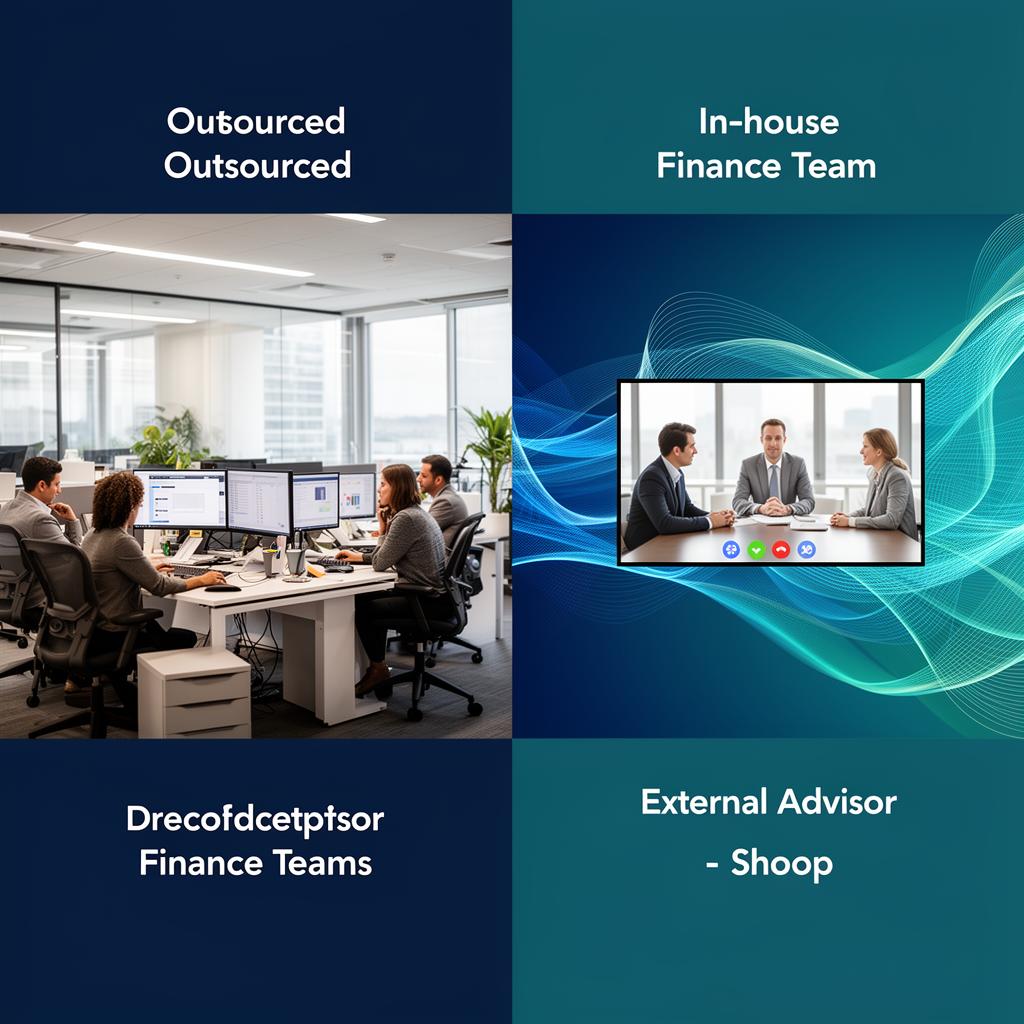
At some point between $3M and $10M in revenue, every business owner faces the same question: should I hire a full-time finance person, or outsource it?
The answer isn't as straightforward as comparing salary costs to a monthly retainer. It depends on your stage, your complexity, and how fast you're moving. Get it wrong, and you either overpay for capacity you don't need—or underbuild the infrastructure your growth demands.
The $3M–$5M Threshold: When the Founder Can't Do It Anymore
Most businesses under $3M in revenue rely on a bookkeeper—sometimes part-time—and the founder fills in the gaps. They review the P&L, manage cash in their head, and make tax decisions in December. It works until it doesn't.
The first sign you've outgrown this model is when you're making financial decisions without current data. If your books are two months behind, if you can't answer how much cash you'll have in 60 days, or if your CPA is the only person who sees your full picture once a year—you've outgrown it.
At this stage, outsourcing is almost always the right move. A fractional bookkeeping and controller engagement gives you the infrastructure of a company twice your size at a fraction of the cost of a single full-time hire.
The $5M–$15M Sweet Spot: The Hybrid Model
This is where it gets nuanced. You likely need someone internal—an office manager, AP clerk, or junior bookkeeper—who handles the daily flow: invoices, deposits, vendor payments, payroll inputs. The volume demands it.
But you probably don't need a full-time controller or CFO. Not yet. The hybrid model pairs an internal transactional person with an outsourced controller who reviews the books, produces management reporting, and provides strategic oversight.
The math matters here. A competent controller costs $120K–$180K fully loaded. A fractional controller engagement runs $3K–$8K per month depending on complexity. If you don't need 40 hours a week of controller-level work—and at $5M–$15M, you almost certainly don't—the outsourced model wins on both cost and quality.
Quality matters because outsourced firms see dozens of companies. They bring pattern recognition and best practices that a solo in-house controller, often operating in isolation, simply can't match.
The $15M–$30M Inflection: Building the Internal Team
Once you cross $15M—especially if you're multi-entity, multi-location, or in a complex industry—you may need a dedicated internal finance person with real depth. This is when a full-time controller or Director of Finance starts to make sense.
Even here, many businesses maintain a fractional CFO relationship alongside their internal team. The CFO provides strategic guidance, board-level reporting, M&A support, and the kind of financial leadership that a controller—no matter how talented—isn't trained to deliver.
Think of it as layers: transactional (in-house bookkeeper or AP clerk), oversight (controller—in-house or fractional), and strategic (fractional CFO or advisory relationship). At each stage, you're upgrading the layer that's become the bottleneck.
The Hidden Costs of Getting It Wrong
Hiring a full-time CFO at $5M in revenue is one of the most expensive mistakes we see. You're paying $200K+ for someone who spends half their time on tasks a bookkeeper should handle because the foundation isn't built yet.
On the other side, trying to run a $20M business with a part-time bookkeeper and an annual CPA visit is a recipe for cash surprises, audit risk, and missed opportunities. You can't negotiate a line of credit, pursue an acquisition, or take on a private equity partner without buttoned-up financials.
The right question isn't *in-house or outsourced?* It's: what does my business need at this stage, and what's the most efficient way to deliver it?
A Decision Framework
Ask yourself these five questions:
1. Do I have current, accurate monthly financials by the 15th of each month? If no, you have a bookkeeping problem—solve it first, usually through outsourcing.
2. Do I have someone reviewing my numbers and explaining what they mean? If no, you need controller oversight—fractional is almost always the right start.
3. Am I making strategic decisions (hiring, expansion, capital) with financial modeling support? If no, you need CFO-level advisory. Fractional works for most businesses under $30M.
4. Is my transaction volume high enough to justify a full-time internal person? If you're processing 500+ transactions per month, an internal AP/AR person makes sense alongside outsourced oversight.
5. Am I planning for an exit, capital raise, or major transition in the next 2–3 years? If yes, you need your financial house in order now—and a fractional CFO can prepare you far more efficiently than building an internal team from scratch.
Key Takeaways
- Under $5M: outsourced bookkeeping and controller oversight is almost always the most cost-effective approach
- The $5M–$15M hybrid model pairs an internal transactional person with outsourced controller and CFO oversight
- A fractional controller costs 30–50% of a full-time hire and brings cross-industry best practices
- Don't hire a full-time CFO until your foundation (clean books, monthly close, cash forecasting) is already built
- The right answer changes as you grow—reassess your financial team structure at every major revenue milestone
Frequently Asked Questions
Next Step
Ready to apply this to your business?
Talk with Aligned Ledger about where you are today and what the right next move looks like for your finance function.
Aligned Ledger is not a CPA firm and does not provide tax, attest, or assurance services.
Related Insights
AI Won't Replace Your Bookkeeper — It Frees Them for the Work That Pays
AI is automating data entry and categorization fast — but it isn't replacing your bookkeeper. It's clearing the busywork so they can finally do the advisory work that actually moves your business forward.
ArticleFrom Spreadsheets to Immutable Records: A CFO's Guide to Migrating Legacy Bookkeeping Systems
A practical, non-technical playbook for finance leaders moving from spreadsheets and legacy software to blockchain-backed, immutable ledgers — covering the business case, migration phases, controls, and team readiness.
ArticleThe Q2 Financial Checkup Every Business Owner Needs
Spring is the perfect time to audit your financial operations. A practical checklist covering cash reserves, tax estimates, vendor terms, and mid-year forecast adjustments before summer hits.